
A chiral aldehyde can clear every analytical check in the lab and still arrive at your plant degraded. Purity, enantiomeric ratio, residual solvents all pass on the CoA. Then the drum is opened after shipping, and the aldehyde has already lost ground.
The failure rarely happens in the reaction step. It happens in the form the material is delivered in. These molecules are often oils with no functional group that lends itself to salt formation or crystallisation, sensitive to oxygen and temperature, losing a little at every sampling, transfer and work-up window. What a lab can make is not automatically something a supplier can ship.
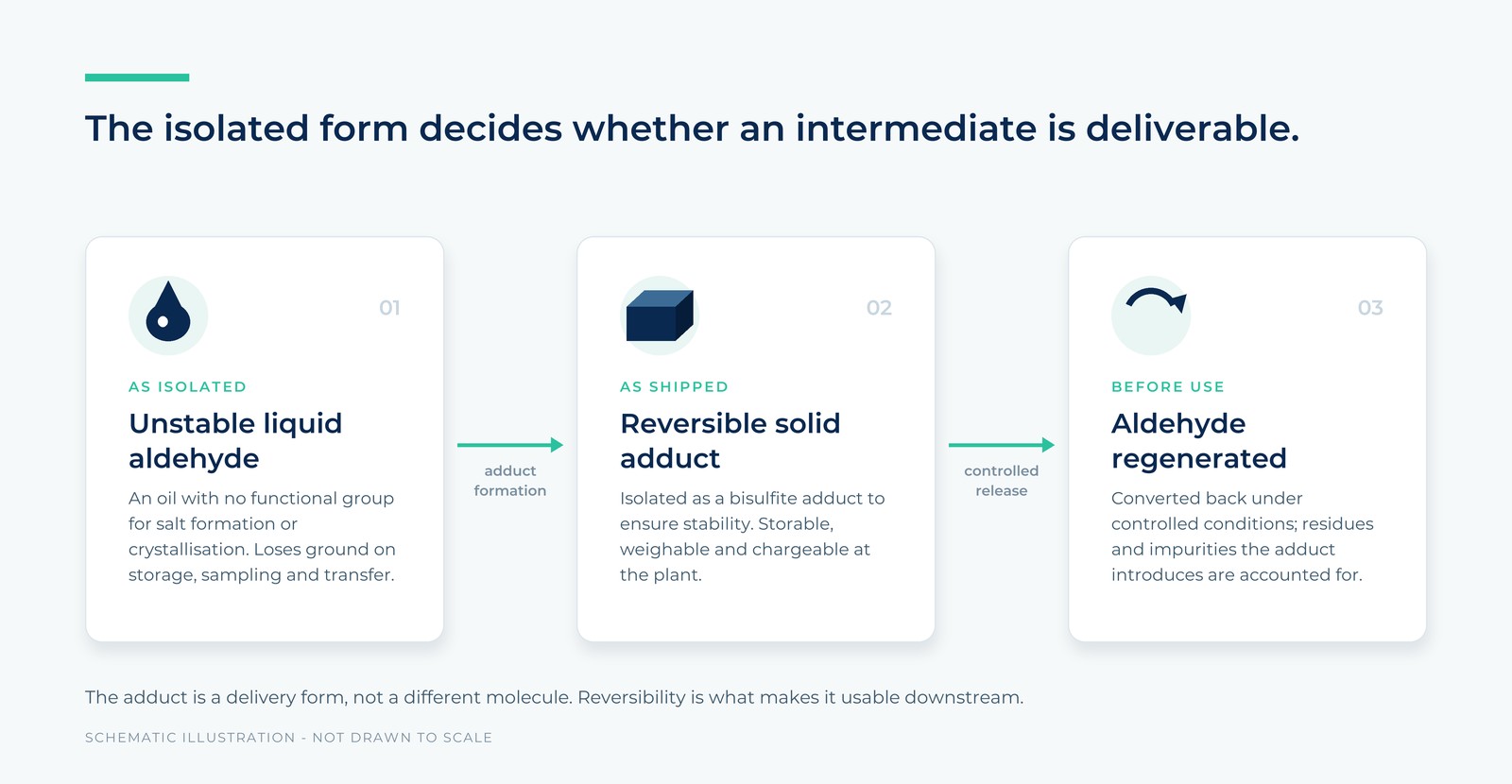
A process-development study on a key aldehyde intermediate for ABBV-576, published in Organic Process Research & Development (DOI: 10.1021/acs.oprd.6c00265), puts the problem in the open: instead of carrying the unstable liquid aldehyde forward, the team isolated it as a bisulfite adduct specifically to ensure stability; adducts of this type are reversible and can be converted back to the aldehyde before use. The case makes one point cleanly: what decides whether an intermediate is deliverable is often the isolated form. Yield comes second.
What actually makes these molecules difficult
The points below are not data from any one project. They are the questions we work through when assessing a structure, drawn from published process cases of this kind.
The route has to clear the plant first. Cryogenic conditions and solvent systems that do not scale comfortably are fine on paper and expensive on a plant floor. Route evaluation should ask whether those conditions still hold at the intended scale, not what yield the literature reports.
Oxygen belongs in the process description. Air-sensitive aldehydes and organometallics usually fail during sampling, transfer and work-up rather than inside the reactor. Inert handling, degassed solvents, controlled oxygen levels and packaging belong in the process description, not in a footnote that says handle under nitrogen.
Rearrangement conditions set the impurity profile. When the aldehyde comes from an epoxidation / Meinwald rearrangement sequence, acid strength, anhydrous conditions and the inert atmosphere all change the impurity profile; that step has to be screened rather than copied from a literature recipe. Stopping an impurity at the step where it forms is far cheaper than purging it at the final isolation.
The chiral strategy belongs in route design. Chasing ee / er at the last isolation pushes both cost and risk into the final batch; where the stereocentre is set, and how it is enriched, should be written into the proposal.
Sometimes the smartest step is to deliver a different form. An unstable oil with no functional group for salt formation or crystallisation can become a reversible solid adduct, solving stability, purification, transport and charging accuracy at once. The release step has to be validated just as carefully, and the impurities and residues the adduct introduces have to be accounted for. Get that right and the customer receives something they can store, weigh and charge.
Where our work sits
We work on pharmaceutical intermediates, chiral building blocks and custom synthesis of optoelectronic materials, developed against a customer’s structure; specific product types and quantities are agreed project by project. For a molecule that is hard to deliver, two questions matter to us: can it be shipped in a stable form, and will the data that travels with it stand up to review? Our process work covers:
- Route scouting and design — comparing published and in-house options for scalability, raw-material availability, safety and waste burden; delivering a route recommendation and a risk list.
- Chiral construction and control — selecting and developing asymmetric synthesis, resolution or biocatalytic routes, with matching chiral analytical methods.
- Handling sensitive materials — controlling charge, sampling, transfer and work-up for air-, moisture- or temperature-sensitive compounds, with inert conditions set by the material.
- Isolate form and stability design — assessing salts, adducts and crystalline forms plus downstream release conditions; delivering an isolate-form recommendation and a stability study plan.
- Scale-up and process transfer — confirming process parameters alongside the impurity profile; delivering batch records and a process description.
- Analytical and impurity work — developing or confirming methods for chiral purity, related substances, residual solvents and water.
Analytical methods, release criteria, packaging and storage conditions, and the documents that ship with the material (CoA, MSDS, stability data and others as agreed) are defined per project at quotation, not from a generic template.
What to send with an enquiry
- Target structure and absolute stereochemistry
- Required ee / er or chiral purity limits
- Quantity for this order and the scale you plan to reach
- Known sensitivities — oxygen, moisture, heat, or shipping and storage constraints
- Analytical tests and delivery documents you need
With those answers we can judge whether a route is worth developing, and which form the intermediate should reach you in.
Have a molecule like this in hand?
Send the structure, the target ee / er and the quantity. We will come back with a feasibility read, the route options we would evaluate, the isolated form we would propose, and the analytical and documentation package behind it. Reach our technical team through the enquiry form or by email at sales@novbond.com.
Technical note: the process discussion above referencing the ABBV-576 chiral aldehyde intermediate is drawn from published literature (DOI: 10.1021/acs.oprd.6c00265) and is included for technical context only. It does not describe work performed by us and does not constitute a product specification or a claim about our capacity, yields, purity levels or certifications.