
The wrong intermediate rarely fails at the point you expect. It clears the certificate of analysis, goes into the deposition system, and only shows up later as low efficiency, a short lifetime, or a batch that behaves differently from the one before it.
Choosing an OLED intermediate is not a matter of reading the purity number on a datasheet. The number matters, but it matters in the context of the stack it sits in. A material that works well in one device architecture can be the wrong choice in another, even at the same stated purity. These are the questions we work through with customers before a structure is fixed.
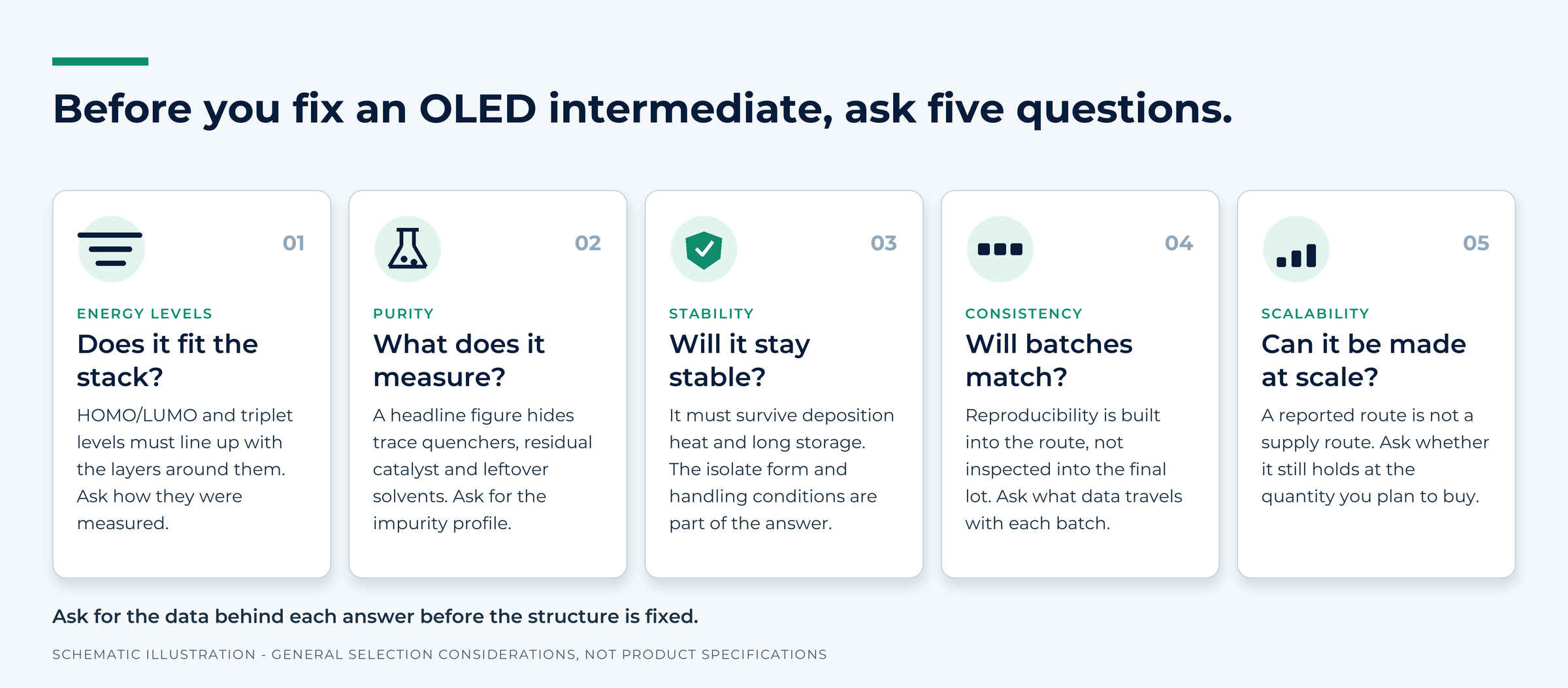
Does the energy level fit the stack?
The highest occupied and lowest unoccupied levels of a transport or host material have to line up with the layers around it. Misaligned levels do not announce themselves as a bad number on a CoA. They appear as a barrier to charge injection, a bottleneck at an interface, or excitons that escape the emissive zone. For phosphorescent systems, the host must hold a triplet level high enough to confine the emitter; where that condition is not met, efficiency leaks away regardless of how clean the material is. Ask for the energy levels, and ask how they were measured.
What is the purity actually measuring?
A single headline purity figure hides a great deal. The impurities that matter in an OLED material are rarely the bulk ones. Trace quenching species, residual catalyst, halogenated by-products and leftover solvents can sit below the level that a routine assay reports and still shorten device life. Two materials can carry the same headline purity and behave very differently in a device. Ask for the impurity profile, not just the percentage, and ask which impurities are controlled at the step where they form.
Will it stay stable in the film and in the bottle?
An intermediate has to survive two different stresses: the thermal load of deposition and the long storage life of the delivered material. A compound that is acceptable on the day it is made can drift during storage, especially where it is air- or moisture-sensitive. Thermal behaviour and morphological stability belong in the material specification, along with the storage and handling conditions that go with them. The form in which the material is shipped is part of that answer.
Will the next batch match this one?
For a device manufacturer, reproducibility is worth more than a single excellent batch. Batch-to-batch consistency has to be built into the process, not inspected into the final lot. That means a defined route, controlled charge and transfer steps for sensitive materials, and analytical methods that are stable enough to compare lots over time. Ask how the process is controlled and what data travels with each batch.
Can it be made at the scale you need?
A structure that is elegant in the literature can be impractical to supply. Raw-material availability, the safety of the conditions, and the burden of purification all change when a route moves from the bench to production. The question to ask is not whether a route has been reported, but whether it still holds at the quantity you plan to buy.
What to send with an enquiry
Target structure, the layer it is intended for, the energy-level and purity requirements that matter for your stack, the impurity profile you need controlled, and the quantity for this order plus the scale you expect to reach. With those answers we can judge which route and which isolate form make sense, and what has to be locked down before the first batch.
How we work
We work on pharmaceutical intermediates, chiral building blocks and custom synthesis of optoelectronic materials, developed against a customer’s structure; specific product types and quantities are agreed project by project. For an OLED intermediate, our process work covers route scouting and design, control of sensitive materials, isolate form and stability design, scale-up and process transfer, and the analytical and impurity work behind each batch. Analytical methods, release criteria, packaging and storage conditions, and the documents that ship with the material are defined per project at quotation.
Building or scaling an OLED material? Send the structure and the layer it is meant for. We will come back with the route options we would evaluate, the issues we would screen for first, and the data package behind the material. Reach our technical team through the enquiry form or by email at sales@novbond.com.
Technical note: the selection criteria above are general considerations drawn from standard OLED materials practice and are provided for discussion. They are not product specifications and do not describe work performed for any specific customer.